
CUE
Established in 1893, Cue was once the center of the Murchison Goldfields boasting a population of around 10,000. (Source: cue.wa.gov.au)
By the time the Dominican Sisters arrived in September 1899, Cue was at the height of its popularity and had already earned the title of capital of the Murchinson.
In September 1899, Bishop Kelly addressed the congregation at Cue on the subject of Catholic education. He informed those present that two Dominican nuns, from the Rosary Convent at Greenough, were expected to open their first Western Australian branch house at Cue in October that year. The bishop also stated that a decision had been made to proceed immediately with the erection of a convent. Nineteen children had enrolled in the Dominican school at Cue when it opened on 2 October 1899. By 1902, the foundation at Cue was well-established and with over 100 pupils enrolled in the day school. (Source: Fields of Gold)
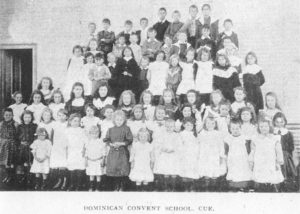
(Source: Outback Family History)
Today, like the days of yesteryear, Cue continues to support both gold and pastoral industries as well as small scale tourism. Its population has fluctuated with the rise and fall of the gold and pastoral industries surrounding it. Today a population of approximately 300 people remains. The region is also rich in Aboriginal culture, with several excellent displays of artwork dating back over 10,000 years.
DAY DAWN
A townsite in the Murchison Goldfields, just 6.6 km from Cue, Day Dawn was originally gazetted as “Bundawadra” in 1894, but was changed to Day Dawn within three months. Gold was discovered here by Ted Hefferman in 1892, and he named his discovery “Day Dawn”, after the time of day that he pegged his claim. The area developed rapidly from 1898 when the famous “Great Fingall” mine was established, and the town of Day Dawn boomed. (Source: Outback Family History) In its prime, Day Dawn was home to over 3,000 people in the early 1900s. (Source: cue.wa.gov.au)
In 1902, the church-school at Day Dawn opened in July. However, the Sisters still had to make a four mile journey from Cue to Day Dawn daily. In the extreme hot of summer and freezing cold in winter, this daily journey was becoming an unattractive proposition.
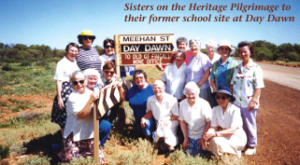 In 1905, three years after opening of the church-school, a practical decision was made by the Dominican Council to erect a convent for the Sisters teaching at Day Dawn. Changes had also taken place that year in relation to the day school at Day Dawn, earlier established in the parish church. One month after opening of the new St Gabriel’s Convent in Cue, Sister Philomena McGarth and two novices took up residence in the newly-erected St Hyacinth’s Convent at Day Dawn, which had been blessed and officially opened on Sunday, 9 April 1905. The completion of this building meant that the Sisters staffing the neighbouring church-school no longer had to commute each day from Cue. (Source: Fields of Gold)
It was on Saturday, 22 April 1905, whilst she was staying at the convent opened in Day Dawn just two weeks earlier, that the intrepid Mother Gabriel Gill met her untimely death at the age of 68. (Source: Fields of Gold) Sickly and emaciated, but hardworking and indomitable to the end, she was buried amid general mourning at Cue; in December 1915, her body was disinterred and reburied in the Dominican cemetery, Dongara. During the final six years of her life Mother Gabriel single-mindedly pursued her goal of bringing Catholic education to the West Australian goldmining districts, despite a rigorous climate, meagre resources and physical privation. (Source: teara.govt.nz) Mother Gabriel had celebrated her golden jubilee of profession in 1904 in Cue. She passed on Holy Saturday. (Source: stdoms.ac.nz)
N.B. Photo Source: CEWA Stories